Peripheral nerves, plexuses and dermatomes
Movement · nerve · spinal root
Shoulder and elbow movements
| Shoulder abduction | Axillary n. | C5 |
| Shoulder adduction | Thoracodorsal n. | C7 |
| Shoulder external rotation | Suprascapular n. | C5 |
| Shoulder internal rotation | Subscapular n. | C6 |
| Elbow flexion (supinated) | Musculocutaneous n. | C5, C6 |
| Elbow flexion (pronated) | Radial n. | C5, C6 |
| Elbow extension | Radial n. | C7 |
Leg movements
| Hip flexion | Femoral n. | L1–L3 |
| Knee extension | Femoral n. | L2–L4 |
| Hip abduction | Superior gluteal n. | L4, L5, S1 |
| Hip extension | Inferior gluteal n. | L4, L5, S1 |
| Hip adduction | Obturator n. | L2–L4 |
| Knee flexion | Sciatic n. (tibial / peroneal) | L5, S1 |
Brachial plexus (C5–T1)
- Axillary n.
- Thoracodorsal n.
- Suprascapular n.
- Subscapular n.
- Musculocutaneous n.
- Radial n.
- Median n.
- Ulnar n.
- Long thoracic n. (C5–C7)
- Dorsal scapular n. (C5)
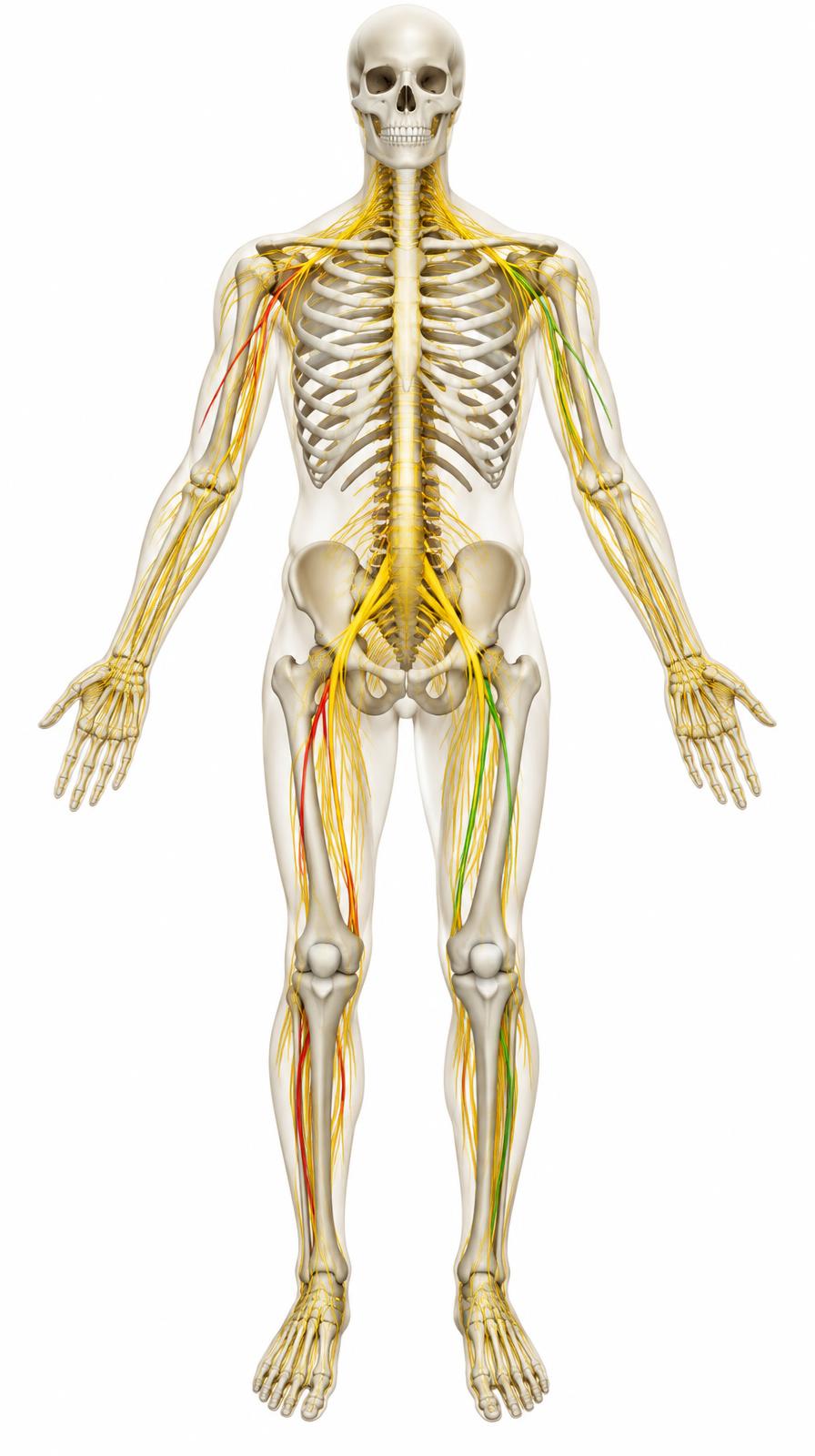 C5–T1L1–S4Radial n.Ulnar n.Median n.Sciatic n.Femoral n.Tibial n.Peroneal n.
Forearm and hand movements
| Forearm supination | Radial n. | C6 |
| Forearm pronation | Median n. | C6 |
| Wrist flexion | Median n. | C7, C8 |
| Wrist extension | Radial n. | C5–C7 |
| Finger extension | Radial n. | C7, C8 |
| Finger flexion, 2nd–3rd | Median n. | C8 |
| Finger flexion, 4th–5th | Ulnar n. | C8 |
| Pinching | Anterior interosseous n. | C8 |
| Thumb adduction | Ulnar n. | C8 |
| Finger abduction | Ulnar n. | T1 |
Foot movements
| Plantar flexion | Tibial n. | S1, S2 |
| Inversion | Tibial n. | L4 |
| Dorsiflexion | Deep peroneal n. | L4, L5 |
| Eversion | Superficial peroneal n. | L5, S1 |
Lumbosacral plexus (L1–S4)
- Iliohypogastric n. (L1)
- Ilioinguinal n. (L1)
- Genitofemoral n. (L1–L2)
- Lateral femoral cutaneous n. (L2–L3)
- Femoral n.
- Obturator n.
- Superior gluteal n.
- Inferior gluteal n.
- Sciatic n. (L4–S3)
- Pudendal n. (S2–S4)
Common injuries and entrapments
- C5–C6 roots: Erb's palsy
- C8–T1 roots: Klumpke's palsy
- C7 root: most often affected by disc herniation
- Thoracic outlet syndrome: lower trunk of the brachial plexus
- Axillary n.: fracture of the humeral neck, shoulder dislocation
- Radial n. in the spiral groove: wrist drop
- Median n.: carpal tunnel syndrome
- Ulnar n.: cubital tunnel at the elbow
- Lateral femoral cutaneous n.: meralgia paresthetica
- Sciatic n.: piriformis syndrome
- Peroneal n. at the fibular head: foot drop
- Tibial n.: tarsal tunnel syndrome
Dermatomes
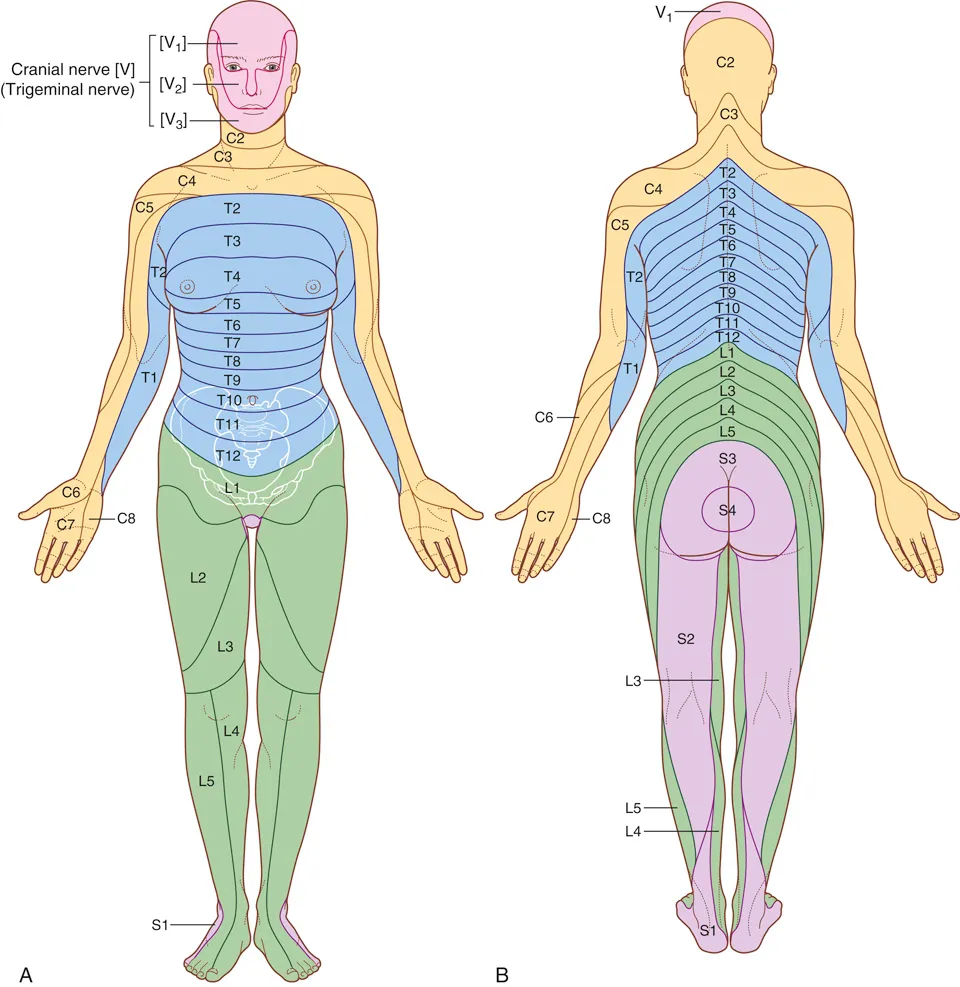
CN V = trigeminal nerve; V₁ ophthalmic, V₂ maxillary, V₃ mandibular divisions.
| C2 | Occiput |
| C3 | Supraclavicular region |
| C4 | Acromioclavicular joint |
| C5 | Lateral elbow |
| C6 | Thumb |
| C7 | Middle finger |
| C8 | Little finger |
| T1 | Medial elbow |
| T2 | Axilla |
| T4 | Nipple line |
| T6 | Xiphisternal level |
| T10 | Umbilicus |
| T12 | Inguinal region |
| L1 | Inguinal / upper medial thigh |
| L2 | Anterior mid-thigh |
| L3 | Medial knee |
| L4 | Medial malleolus |
| L5 | Dorsum of foot |
| S1 | Lateral heel / foot |
| S2 | Popliteal fossa |
| S3 | Ischial region |
| S4–S5 | Perianal region |
Illustrative dermatome territories and common sensory landmarks, not exact diagnostic boundaries. Adjacent territories overlap; maps vary. The perianal S4–S5 landmark is assessed separately and is not visible in this posterior view. Facial sensation is supplied mainly by CN V.